How Businesses Can Leverage AI for Growth, Innovation, and Sustainability

Christa Swain • March 17, 2025

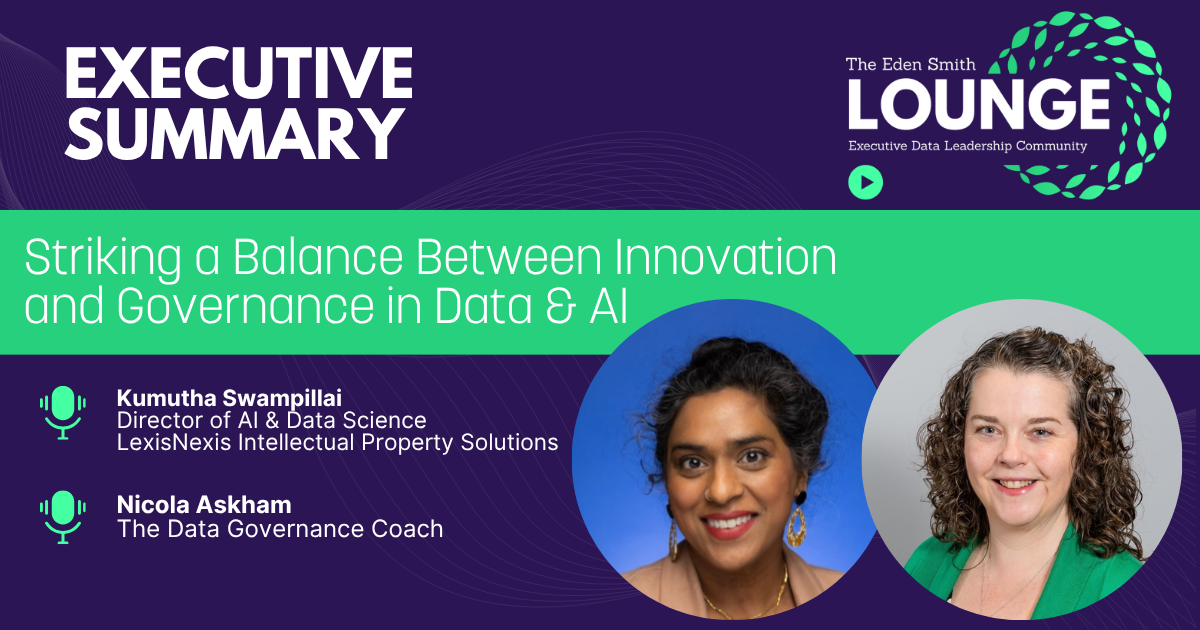
At the latest Eden Smith Data Leaders Executive Lounge , Hannah Foxwell and Lee Fulmer led a dynamic and thought-provoking discussion unfolded on AI adoption, strategic business impact and sustainability. Operating under Chatham House Rules , our community of data leaders explored real-world AI applications, challenges and opportunities.

AI as a Business Enabler, Not a Replacement

A recurring theme was AI’s role as an assistant rather than a replacement for human expertise. Speakers shared examples of AI’s transformative impact, from reducing construction planning from six weeks to just 30 minutes to driving significant ROI through bespoke AI solutions tailored to specific business needs. The conversation underscored that AI’s true value lies in iterative experimentation , allowing businesses to adapt and optimise over time.

Trust, Verification and Data Readiness

A staggering 72% of high-performing AI pilots face data quality issues , highlighting the need for trust and verification in AI implementation. Clean, well-structured data remains a fundamental prerequisite for success, and organisations must first ensure their AI initiatives are built on a solid foundation of governance and data integrity .

Strategic AI Adoption: Focusing on Business Challenges

Speakers emphasised the importance of solving genuine business problems rather than adopting AI for AI’s sake . Whether in pharmaceuticals, FMCG or finance , AI’s success hinges on aligning solutions with core business objectives. The group also discussed the need for small, measurable wins to build momentum and executive buy-in.

AI Regulation: Balancing Innovation and Compliance

As AI legislation continues to evolve, participants debated how regulation could impact the UK’s competitive stance in AI development . While governance is essential , overly restrictive policies could stifle innovation . The consensus? Businesses should focus on ethical AI adoption while staying ahead of potential legislative shifts.

Sustainability Spotlight: Sapling Spirits

Our evening also featured an inspiring presentation from Sapling Spirits , a climate-positive brand planting a tree for every bottle sold. Their innovative approach to sustainable packaging and reforestation serves as a model for businesses looking to balance profit with purpose .

Key Actions:

✅ Complete the AI Readiness Survey – Assess your organisation’s AI preparedness and receive strategic recommendations.
✅ Continue the AI Adoption Discussion – Connect with experts to explore practical AI implementation.
✅ Engage in Information Governance Best Practices – Learn how to ensure AI-driven decisions are based on reliable, well-structured data .

As AI continues to reshape industries, our Data Leaders Lounge remains a hub for candid conversations and collaborative innovation . Stay connected for upcoming events and deeper dives into AI strategy, governance and real-world applications .

Take Part in the AI Readiness Survey

Would you like to take part in our AI Readiness Survey ?

Will take just 10 minutes to take part and will help inform understanding of AI adoption, maturity and bench mark this data across various industries. Everyone who takes part will receive:

✅AI Maturity snapshot using our proprietary AI Readiness Scale
✅Opportunity to take a deep dive into the results and what it means for your business
✅Exclusive access to the white paper once the survey has closed and all the data has been analysed

Click through to be part of this valuable research and join us in shaping the future.

By Christa Swain December 3, 2025
Executive Summary: AI, Ethics, and Human-Centred Design Our recent Leaders Advisory Board event - designed in partnership with Corndel - featured three engaging sessions that explored how AI impacts human cognition, customer experience, and fairness. Here's what we learnt: 1. Think or Sink – Are We Using AI to Enhance or Reduce Cognitive Ability? Speaker: Rosanne Werner , CEO at XcelerateIQ & ex Transformation Lead at Coca-Cola Roseanne opened the day with an interactive and thought-provoking session, firmly positioning AI: “AI should be your sparring partner, not your substitute for thinking.” Her research revealed a striking insight: 83% of people using LLMs couldn’t recall what they wrote, compared to just 11% using traditional search . The message? It’s not about avoiding AI, but using it in ways that strengthen thinking , not outsource it. Roseanne explained how our brains form engrams - memory footprints that enable creativity and critical thinking. Over-reliance on AI risks weakening these pathways, reducing retention and problem-solving ability. She introduced the Mind Over Machine Toolkit , six strategies to use AI as a thinking partner: Provide Context First – Frame the problem before asking AI. Use AI as a Challenger – Stress-test ideas and uncover blind spots. Iterative Co-Creation – Collaborate, refine, and evaluate. Document Your Thinking – Keep reasoning visible. Reflective Prompts – Support reflection, not replace judgment. Sparring Partner – Test assumptions and explore risks. Roseanne summed it up with a simple rule: use Sink for low-value, repetitive tasks, and Think for strategic, creative decisions. 2. Designing Chatbots with Human-Centred AI Speaker: Sarah Schlobohm , Fractional Chief AI Officer Sarah brought a practical perspective, drawing on experience implementing AI across sectors - from banking and cybersecurity to rail innovation. She began with a relatable question: “Who’s been frustrated by a chatbot recently?” Almost every hand went up. Through a real-world example (redacted out of politeness), Sarah illustrated how chatbots can fail when designed with the wrong priorities. The chatbot optimised for deflection and containment , but lacked escape routes , sentiment detection, and escalation paths - turning a simple purchase into a multi-day ordeal. “Don’t measure success by how well the chatbot performs for the bot—measure it by how well it performs for the human.” Sarah introduced principles for better chatbot design: Human-Centred Design – Focus on user needs and emotional impact. Systems Thinking – Consider the entire process, not just chatbot metrics. Escalation Triggers – Negative sentiment, repeated failures, high-value intents. Context Awareness – Detect when a task moves from routine to complex and route accordingly. The takeaway? Automation should remove friction from the whole system - not push it onto the customer. 3. Responsible AI and Bias in Large Language Models Speaker: Sarah Wyer , Professional Development Expert in AI Ethics at Corndel “When we create AI, we embed our values within it.” She shared her journey tackling gender bias in large language models , from GPT-2 through to GPT-5, and highlighted why responsible AI matters. AI systems reflect human choices - what data we use, how we define success, and who decides what is fair. Real-world examples brought this to life: facial recognition systems failing to recognise darker skin tones, credit decisions disadvantaging women, and risk assessment tools perpetuating racial bias. Even today, LinkedIn engagement patterns show gender bias! Sarah made the point that simple actions - like testing prompts such as “Women can…” or “Men can…” - can reveal hidden disparities and spark vital conversations. To address these issues, Sarah introduced the D.R.I.F.T framework , a practical guide for organisations: D – Diversity : Build diverse teams to challenge bias. R – Representative Data : Ensure datasets reflect all user groups. I – Independent/Internal Audit : Test outputs regularly. F – Freedom : Create a culture where employees can challenge AI decisions. T – Transparency : Share processes without exposing proprietary code. Wrapping up the final session - before we opened the floor to panel questions and debate - Sarah created the opportunity to discuss how we address AI bias within our organisations by stepping through the DRIFT framework. Shared Themes Across All Sessions AI is powerful, but context matters . Human oversight and ethical design are critical . Use AI to augment thinking , not replace it. Measure success by human outcomes , not just automation metrics. We've had such great feedback from this event series - especially around the quality of speakers and the opportunity to have meaningful conversation and debate outside of functions. Definitely more in the events plan for 2026! If you'd like to be part of the conversation please navigate to our LAB events page to register your interest .
Woman and man touching hands, digital data flowing between them, with digital head projections.
By Eden Smith December 3, 2025
Discover why teams resist AI and how leaders can drive real buy-in using behavioural science, transparency, and human-centred adoption strategies.
People in office meeting with person on screen via video call.
By Eden Smith December 2, 2025
Discover why Data Translators, hybrid talent blending business, data, and communication, are becoming essential as organisations move beyond pure tech roles.
Show More