The Eden Smith Exec Lounge Summary

April 21, 2026

From Data Delivery to Durable Value: What Leaders Are Really Grappling With 

At the latest Eden Smith Exec Lounge, senior data and technology leaders came together to explore a question that continues to challenge organisations across sectors:


Why does value from data and AI still feel so hard to realise - despite record investment, tooling and talent? 


Rather than focusing on platforms or architectures, the conversation explored something deeper: how leadership behaviours, incentives and operating models shape whether data and AI ever translate into meaningful outcomes. What followed was one of the most open, energetic and honest discussions we’ve seen in the Lounge to date. 


From delivery focus to outcome partnership


Helen Mannion opened the discussion by challenging a long‑standing assumption: that strong data foundations alone are enough to unlock value. While data quality and platforms clearly matter, the group reflected on a missing layer beneath the technology -  a true outcome-focused partnership between data teams and the business


Many organisations believe they have this partnership in place. In practice, the discussion surfaced a familiar pattern: data teams positioned as highly responsive delivery engines, while business teams assume value will emerge “once the foundations are built”. The result is activity, not outcomes - dashboards delivered, platforms migrated, models deployed - but limited behavioural change or decision impact. 


A recurring insight was that delivery success is often mistaken for value creation, and that projects frequently stop just short of embedding, adoption and meaningful change. 


When goals aren’t real goals 


One of the most resonant themes was the idea that many initiatives begin with goals that aren’t truly shared outcomes. Leaders discussed how programmes often start with requests (“we need a dashboard”, “we need to move platforms”, “we need to implement AI”) rather than decisions, behaviours or business results that should change as a consequence. 


Without a genuinely shared outcome, assumptions quickly creep in: assumptions about what stakeholders need, how success will be measured, and when work is “done”. This makes it difficult for data leaders to challenge direction and even harder to hold mutual accountability for results. 


The pull back towards technology ownership 


The group also reflected on why so many organisations appear to be drifting back towards technology‑led ownership of data and AI. Several contributors noted that increasing AI adoption is reinforcing this shift, with AI seen primarily as a technical capability rather than a strategic, organisational one. 


The consensus wasn’t that where data sits matters most - but rather that without clarity of purpose, data leadership risks being measured on delivery speed rather than business impact, regardless of reporting lines. 
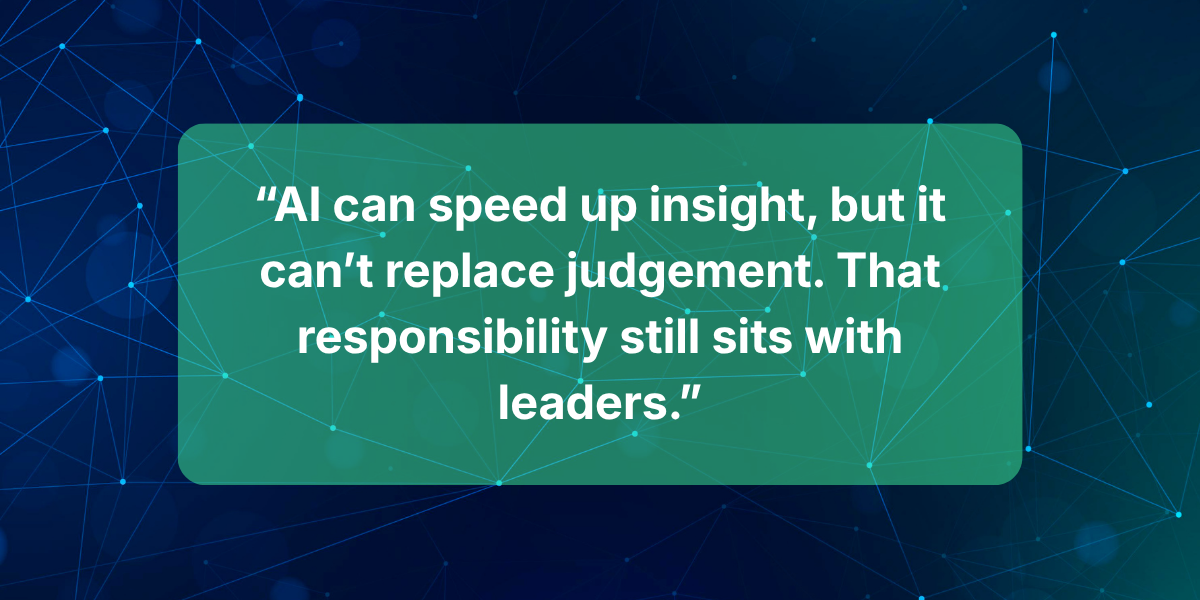
blue background with the quote

AI, judgement and the risk of hollow progress 


Building on these themes, Paul Parker introduced the people dimension of AI adoption - not just skills, but judgement, accountability and longterm organisational resilience. While AI adoption is accelerating, the discussion highlighted growing concern that short‑term efficiency gains may be coming at the expense of capability building and future leadership pipelines. 


Leaders shared lived experiences of AI outputs being accepted without sufficient challenge, context or understanding - creating new dependencies rather than better decisions.


A clear message emerged: AI can accelerate insight, but it cannot own judgement. That responsibility remains human and must be designed deliberately. 


The human challenge beneath the technology 


Throughout the session, participants repeatedly returned to one idea: delivery does not create value unless it changes behaviour. Whether discussing data platforms, AI tools or operating models, the group agreed that outcomes only materialise when organisations invest in the conditions that allow people to think differently, act differently and decide differently. 


This includes how early‑career talent is developed, how experience is passed on, and how leaders balance urgency with stewardship. The conversation was notably candid on the risks of prioritising short‑term results at the cost of long‑term capability. 


A community conversation, not a finished answer 


As always, the Exec Lounge didn’t end with a neat conclusion - and that was the point. The strength of the evening was in surfacing tensions leaders are actively living with: 

  • Outcome versus delivery 
  • Speed versus sustainability 
  • Automation versus judgement 
  • Experimentation versus adoption 


What united the discussion was a shared recognition that value from data and AI is not a technology problem alone - it is a leadership one


We’re grateful to Jez Clark for hosting, and to Helen Mannion and Paul Parker for catalysing such a thoughtful and energising conversation - and to our community for continuing to show up with honesty, curiosity and generosity. 


The dialogue will continue at our next Exec Lounge in July. If you’re a data leader and want to be part of the conversation, you can register your interest or join our closed LinkedIn group

data decoded 2026 marketing with a photo of Nick Deveney
April 27, 2026
Talent & culture - not just technology - will define AI success. Key takeaways from the Data Decoded London roundtable on leadership, data literacy, governance, and building AI-ready organisations.
March 25, 2026
Executive Summary
a selfie  of Christa Swain holding up a litter picker grabber
By Christa Swain March 11, 2026
Eden Smith’s ES10 volunteering initiative inspired one small habit with real impact: litter picking on daily walks and discovering how small actions make a difference.
Show More