FOUR-ZONE DATA ARCHITECTURE:
Beyond Traditional Medallion Architecture
Traditional Medallion Architecture commonly follows: Bronze → Silver → Gold. This works well, but at enterprise scale, the
Silver layer can become overloaded with cleansing, standardisation, joins, enrichment and business logic.
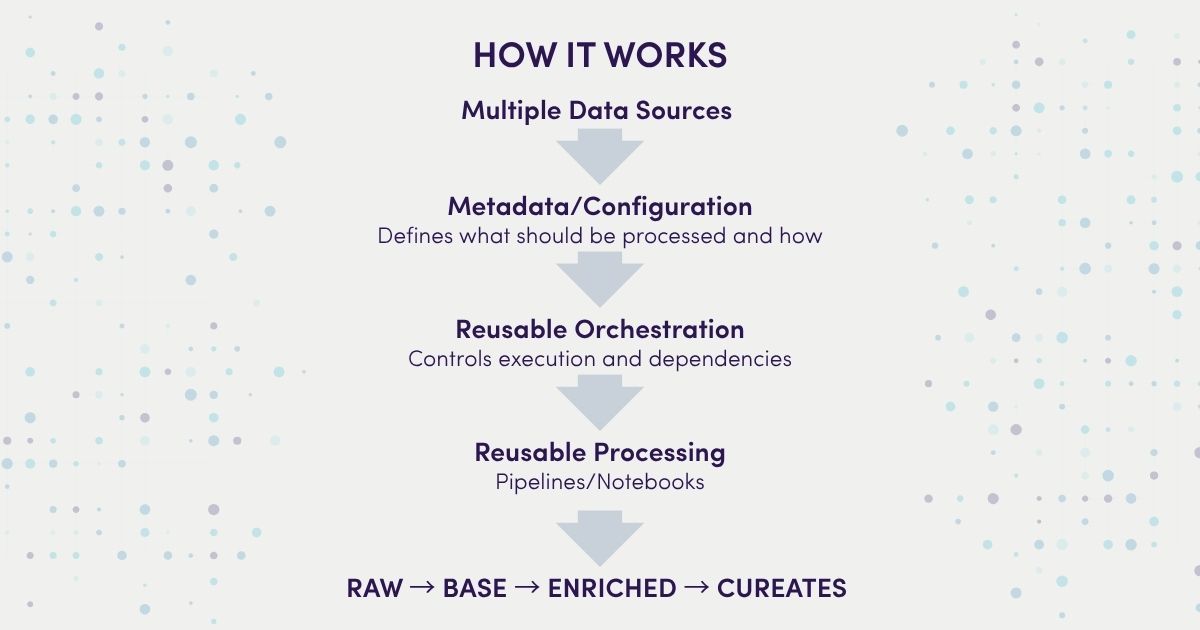
A four-zone architecture separates these responsibilities: RAW → BASE → ENRICHED → CURATED. The objective is not simply to add another layer. It creates clear separation between
source preservation, technical standardisation, data integration and business-ready data, while providing a reusable foundation for
BI, Data Science, Machine Learning and AI.
The Four Zones
1.
RAW | Preserve
Stores data as received from the source with minimal modification.
Purpose: Source integrity, Traceability, History, Reprocessing
2. BASE | Standardise
Creates a clean and technically consistent representation of each source dataset while preserving its business meaning.
Purpose: Data types, Standardisation, Cleansing, Quality checks, Incremental processing
3. ENRICHED | Integrate & Enable
Combines related datasets and adds useful context without making the data report-specific.
Purpose: Joins, Cross-source integration, Reference data, Reusable business entities, Analytical preparation
Why it matters: The Enriched layer becomes a reusable Data & AI enablement layer. Data Science, ML and AI workloads can consume clean, integrated and contextualised data without rebuilding source-level engineering.
4. CURATED | Business Ready
Applies governed business rules and creates trusted data products for business consumption.
Purpose:
Facts, Dimensions, KPIs, Aggregations, Reporting-ready datasets
Why Four Zones? The rationale!
Clear Separation - Each type of transformation has a defined responsibility.
Reusable Data - Integration is performed once and reused across downstream workloads.
AI & ML Ready - Enriched data can directly support Data Science, ML and AI use cases.
Maintainable & Scalable - Changes are easier to isolate, troubleshoot and extend as the platform grows.
One Foundation - Multiple Consumption Paths
Sources → RAW → BASE → ENRICHED
From ENRICHED:
→ CURATED → Power BI | Reporting | KPIs
→ Data Science | Machine Learning | AI / GenAI
The Enriched layer creates a reusable bridge between core data engineering, governed business reporting and advanced AI/ML workloads.
METADATA-DRIVEN FRAMEWORK
Reusable Data Engineering Through Configuration
As data platforms grow across
multiple sources and hundreds of tables, creating and maintaining individual hard-coded pipelines for every dataset becomes difficult to scale.
A metadata-driven framework separates
configuration from execution logic.
Instead of hard-coding source, target, load strategy and processing behaviour into individual pipelines, these values are stored as metadata and interpreted by reusable orchestration and processing components.