Black Friday, asked to AI
Black Friday, asked to AI: plenty of names, very few picks
This Black Friday, more UK shoppers will start with a question to an AI assistant. We wanted to know what they hear back.
About eight weeks before the sales, we put 12 everyday Black Friday questions to Claude, ChatGPT (signed out), Gemini and Google's AI Overview, five times each: 240 answers in all. None of the questions mentioned the UK.
The assistants name lots of brands, 7.8 in the average answer, yet only 10 of the 240 answers settle on one. Seven of those ten are PlayStation. Sony appeared in every headphone answer, and not one of them picked a winner.
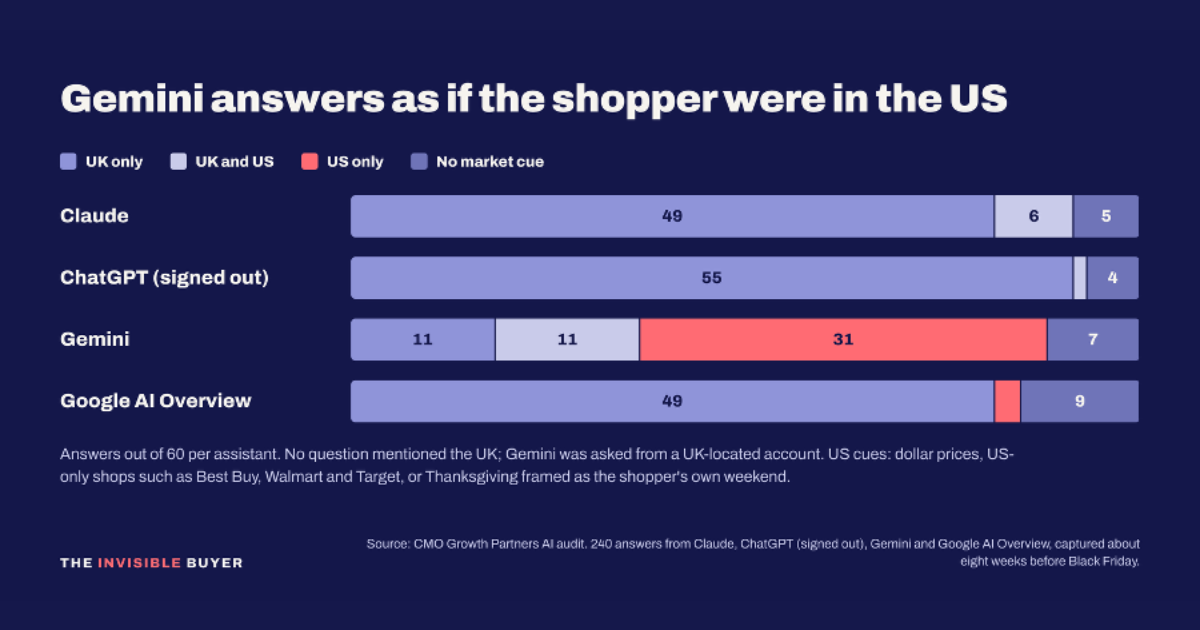
Prices were all over the place. Some assistants dated last year's prices with care. Others showed them as today's deal, and Gemini gave 42 of its 60 answers a US slant, for a shopper in Britain.
And the four assistants rarely agree on which brands to put first, so there is no single AI ranking to win.
Being found does not equal being chosen, and every retail and brand leader heading into peak should plan for it. Read the full article to see who gets picked, where the prices come from and what to fix before 27 November.
Black Friday, asked to AI: why so few brands get chosen
This year, more UK shoppers will start Black Friday with a question. "Best Black Friday hoover deals." "Should I wait for a new TV?" "Amazon, Argos or Currys?"
They will type it, or say it, to an AI assistant, and they will act on what comes back.
So we asked first. About eight weeks before Black Friday, my team put 12 everyday Black Friday questions to four assistants: Claude, ChatGPT (signed out, the way many shoppers use it), Google's Gemini, and the AI Overview at the top of Google's results.
We asked each question five times on each platform, which gave us 240 answers. None of the questions said "UK". We wanted to hear what a shopper in Britain is told when they ask the way people really ask.
For anyone trading in Q4, three findings matter: the assistants name lots of brands and pick very few, pricing is all over the place, and the four assistants rarely agree with each other.
Plenty of names, very few picks
Almost every answer names a brand: 223 of the 240. The average answer names 7.8. That sounds like good news for visibility, and up to a point it is. If your brand is missing from AI answers about your own category, that is a problem worth fixing today.
Very few go further than that. Only 10 of the 240 answers make a single, clear pick: one brand, one product, buy this. That is about one answer in 25.
This is very evident in consumer electronics. Ask about noise-cancelling headphones, and Sony appears in all 20 answers, Bose in 16. Not one of those 20 answers picks a winner. Ask about cordless hoovers and Dyson and Shark each appear in 19 of 20, with just one pick across the lot.
“Being found does not equal being chosen. A brand can sit in every answer and still win no decision.”
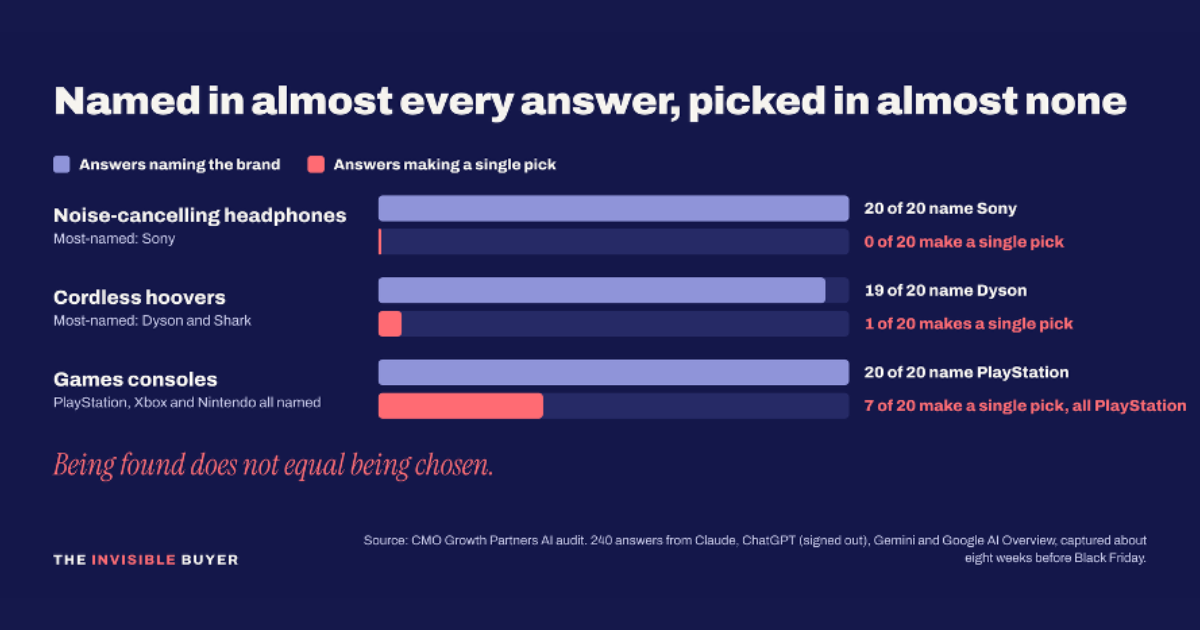
So the shopper gets a shortlist and is left to decide. That gap is what my book is about. Being found does not equal being chosen. A brand can sit in every answer and still win no decision, because the assistant hands the choice back to the shopper, and then to whichever retailer page they click next.
Why PlayStation is the exception
There is one category where the assistants do choose. Ask about consoles and PlayStation, Xbox and Nintendo each appear in all 20 answers. Seven single picks land there, and all seven are PlayStation. Seven of the ten picks in the whole audit belong to one brand in one category.
The reason is due to the question, which says Black Friday. The assistants read it as a question about which console will be the best deal, and the deal press puts PS5 at the top of its discount lists. The pick follows the price story the web is telling.
That is a lesson for any brand heading into peak. How a question is framed shapes the answer, and in a sale season the answer leans on what has been written about your offer. If you want the pick, your deal has to be integral to your story, in the places the assistants read.
Pricing was all over the place
Most prices reach these answers through the web pages an assistant reads at the moment it is asked. Eight weeks before Black Friday, the pages that rank for "Black Friday headphone deals" are often last year's round-ups, sometimes kept at a web address with no year in it. The assistant reads the page and repeats the price, whatever year it comes from. Prices taken from retailers' own product listings came out current.
We checked every priced product: 658 prices in the 111 answers that quote any. Three stale deals, from two brands, were shown to shoppers as current. Google's AI Overview told shoppers four times that the Sony WH-1000XM5 was "currently marked down from £379 to £245". All four came from one Cyber Monday page written for last season. Gemini put a Shark Stratos at £161 to £250 under a column headed "Current / Deal Price". On the same day, Claude dated that same price to last year's sale.
We only counted a price as stale when we could prove it. Another 112 prices were shown as current deals with no date we could check, so the real number is likely to be higher.
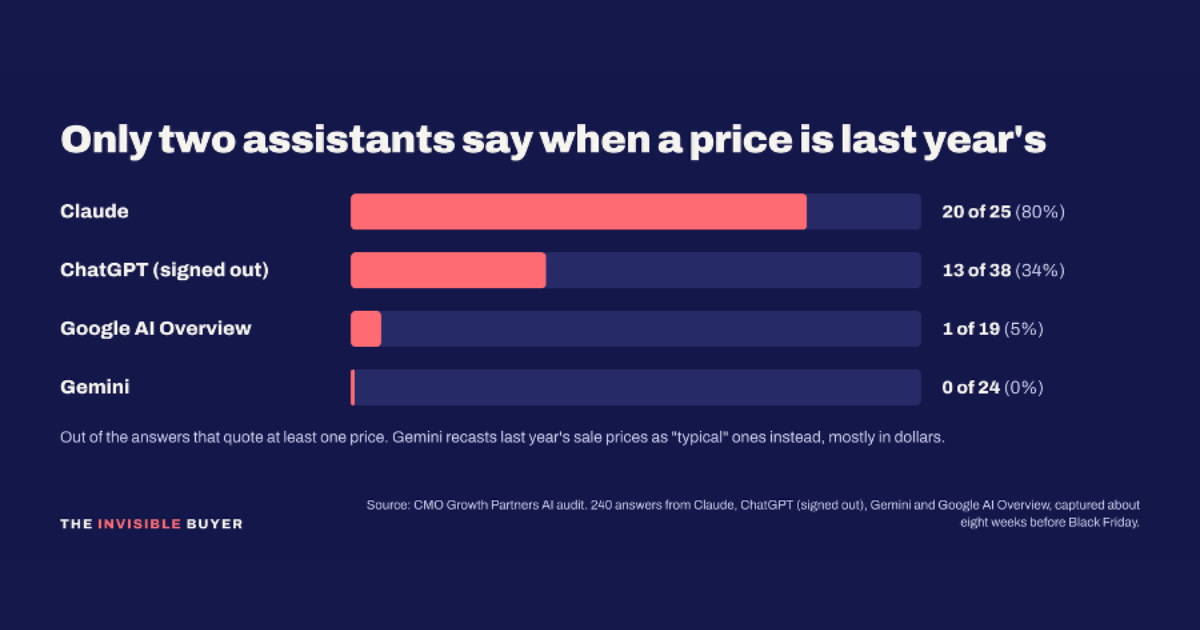
The bigger difference is what each assistant tells the shopper about an old price. Claude labels prices as last year's in 20 of the 25 answers where it quotes them. Signed-out ChatGPT does so in 13 of 38. Google's AI Overview does it once in 19. Gemini never does. It recasts last year's sale prices as "typical" or "expected" ones, mostly in dollars, for a shopper in Britain.
The assistants rarely agree
Ask four assistants the same question and you get four different shortlists. We compared each platform's usual top three brands on every question. On average, the overlap between any two platforms' top threes was only about a quarter. On the broadest question, "best black friday deals" typed the way people type it, the overlap was close to nothing.
They do not always agree with themselves either. Ask the same assistant the same question five times and the top three shifts. Google was the steadiest. Gemini and signed-out ChatGPT moved the most.
Timing advice splits too. Asked whether to wait until Black Friday for a new TV, Claude and ChatGPT said wait in all five answers. Gemini said "it depends" in all five. Google gave all three verdicts. Asked whether Cyber Monday beats Black Friday, all 20 answers said it depends.
The reason is that each assistant reads different sources and weighs them differently. ChatGPT cites Which? in 38 of its 60 answers. Google's AI Overview leans on YouTube, Which?, Currys and John Lewis. For a brand, this means there is no single AI ranking to win. Your share of answer depends on which assistant your customer happens to open.
“Gemini never told a shopper that a price was last year's. Claude did in 20 of the 25 answers where it quoted prices.”
Gemini assumes the shopper is in the US
Gemini gave an answer with a US slant, such as dollar prices or US-only shops like Best Buy, Walmart and Target, in 42 of its 60 answers, from an account set up in the UK. Claude and signed-out ChatGPT gave no US-only answers at all. If some of your customers use Gemini, some of them are getting advice written for a different market.
Retailers: named often, chosen rarely
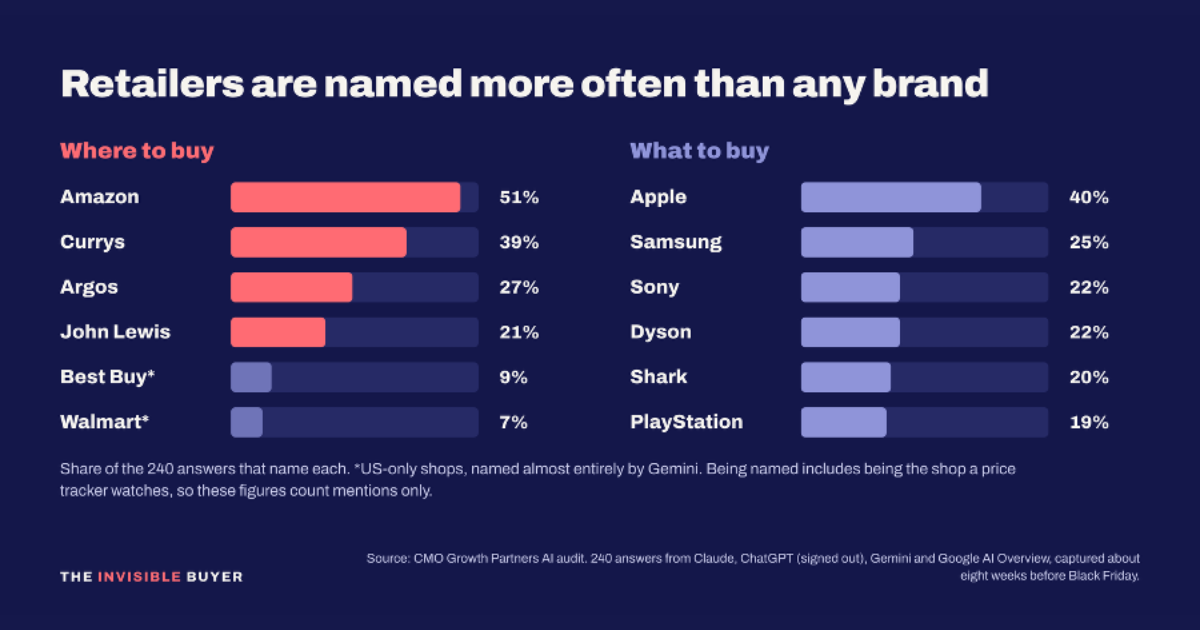
Retailers are named far more often than they are recommended. Amazon is named in 51% of answers, Currys in 39%, Argos in 27% and John Lewis in 21%. Being named includes being the shop a price tracker watches, so they do not mean that half of shoppers are sent to Amazon.
Price trackers come up often too. CamelCamelCamel, an Amazon price tracker, is named in 37% of answers, more often than any UK deal site. ChatGPT names a retailer in its own words in only 20 of its 60 answers, against 58 of 60 for Claude. It moves retailers into its product cards instead, in 39 of 60. For retailers, those cards now work like shelf space, and they run on product feeds.
Paid and earned now share the screen
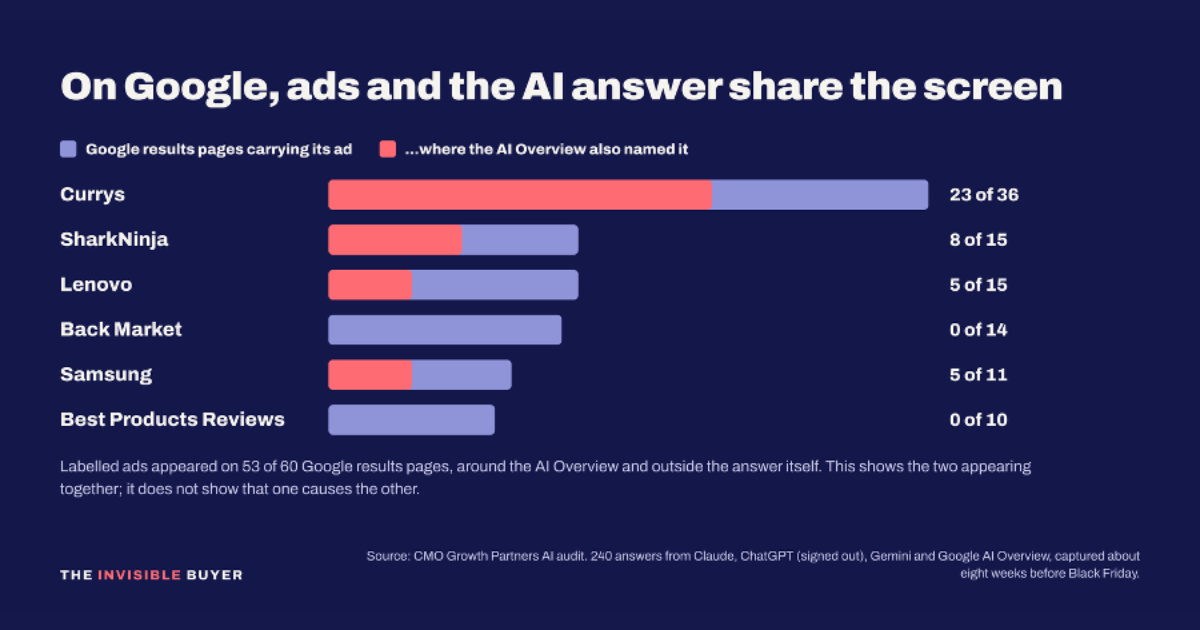
On Google, labelled ads appeared on 53 of the 60 results pages, and above the AI Overview on 20. On 33 of those 53 pages, the AI Overview named at least one of that page's own advertisers. Currys advertised on 36 pages and was named in the overview on 23 of them.
These figures show ads and answers on the same page. The ads sit around the overview, outside the answer itself, and we cannot say one causes the other. It does show how closely retail media and AI answers now sit together, and how much of a retailer's Q4 visibility on Google rests on both. Some of that ad copy was stale as well. One SharkNinja ad was still promising "Summer Savings".
What this means for leaders
In most businesses, nobody owns this yet. The answer a shopper reads is shaped by your product pages, your feeds, your PR, your reviews, your retail media and your retail partners. Those sit with different teams, often with different targets, and none of them is measured on whether the assistant picks you.
That needs to change. Someone on the leadership team should own your share of answer, the way someone owns search or retail media today. They need a regular read of what the main assistants say about your category, a short list of the pages and partners that feed those answers, and the authority to get ecommerce, brand, PR and trade marketing working on it together.
It also changes the skills a team needs. The marketers who will do well here can read data, write for people and machines alike, and work across the line between brand and retailer. If you are hiring or developing people for 2027, those are the skills to look for.
What to do before 27 November:
For Leaders:
- Ask the questions your customers ask. Run your category through all four assistants, in plain shopper language, several times each. Being named is the first test. Being picked is the holy grail.
- Clean up the pages the assistants read. They repeat what deal pages and reviews say. Get this year's prices, models and Black Friday pages live, dated and easy to read, and retire or redirect last year's.
- Give the assistant a reason to choose you. The picks went to the brand with the clearest deal story. Put your offer in front of the publications the assistants cite most: Which?, the review sites and the deal press.
For Retailers
- Treat product feeds as a peak-season channel. Prices drawn from retailer listings came out current. Make sure your Google Merchant Center and ChatGPT product feeds update the moment a sale starts and ends.
- Check paid and earned together. Look at the full results page your shoppers see, ads and AI Overview side by side, and refresh any copy still running from the summer.
Preparing for a shopper you never see
Black Friday rewards preparation. This year, part of that is preparing for a shopper you never meet: the AI assistant that reads the web on your customer's behalf and decides what to show them. I call it the invisible buyer.
The answers in this audit came before a single sale went live, and they will change as the deal pages change, so there is still time to act. The brands that check now, fix their pages and feeds, and give the assistants a clear reason to choose them will be the ones that move from being found to being chosen.
The Invisible Buyer by Naureen Mohammed is available on pre-release and out on 20 November. It draws on more than 5,000 AI answers across 13 UK consumer categories. Eden Smith and Naureen are bringing retail and brand leaders together to talk about this in the new year.
Register your interest and we will keep you updated as plans take shape!
About the audit. Twelve Black Friday questions, asked five times each on Claude, ChatGPT (signed out), Gemini and Google's AI Overview: 240 answers, captured about eight weeks before Black Friday, before this year's deals were live. Web search was on for every assistant. Gemini was used from a UK-located account. Figures describe this sample and are not a forecast of what shoppers will see on the day.