Executive Summary - Striking a Balance Between Innovation and Governance in Data &AI
Why successful AI adoption depends on more than technology
Across organisations, leaders are being challenged to deliver tangible value from AI investments while managing increasing expectations around governance, risk, accountability and trust. The question is how to adopt AI responsibly without slowing innovation to a standstill.
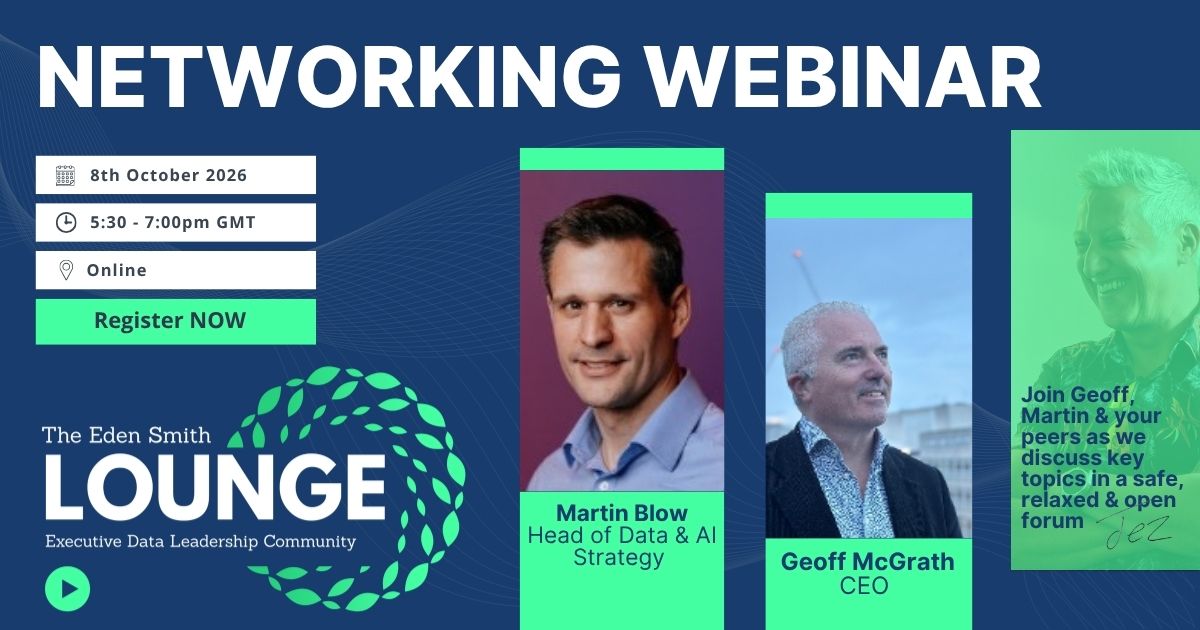
At a recent Eden Smith Lounge event, senior data, AI and transformation leaders came together under Chatham House Rules to explore this challenge from multiple perspectives.
The conversation highlighted a growing consensus: organisations that scale AI successfully no longer need to choose between innovation and governance. Instead, they need to build frameworks that enable both.
The evening featured thought-provoking sessions from Kumutha Swapillai, who shared practical lessons from deploying agentic AI solutions in real-world environments, and Nicola Askham, who explored why many AI strategies overlook one of the most critical factors for success: people.
Agentic AI Is Changing the Rules of Delivery
As organisations move beyond generative AI pilots and begin deploying autonomous and semi-autonomous AI agents, the complexity of delivery increases significantly.
While much of the attention around AI focuses on models and technology, the reality is that successful deployment is often determined by something far more human: stakeholder alignment.
Organisations must bring together product teams, engineers, governance professionals, business leaders and subject matter experts - often with competing priorities and differing definitions of success.
The discussion highlighted a key lesson emerging across the industry:
governance needs to be embedded throughout development, testing and deployment.
For many organisations, this means evolving how they evaluate success. Traditional software testing approaches are often insufficient for AI systems that generate dynamic outputs or make autonomous decisions. Instead, leading organisations are introducing continuous evaluation frameworks, human oversight mechanisms and cross-functional review processes to ensure AI remains effective, reliable and trustworthy over time.
What AI leaders are learning
- Trust is becoming as important as accuracy.
- Evaluation frameworks require business ownership, not just technical oversight.
- Stakeholder engagement is a critical success factor from day one.
- Continuous monitoring is essential in agentic environments.
- Governance works best when it enables innovation rather than restricts it.
The People-Shaped Gap in Many AI Strategies
Whilst organisations continue to invest heavily in AI capabilities, a recurring theme during the discussion was that many transformation programmes underestimate the human factors that determine success.
Technology can be purchased. Culture, behaviours and trust need to be built.
Many organisations have developed ambitious AI roadmaps, yet continue to face challenges around adoption, accountability, data quality and organisational readiness. Often, the root cause is not a lack of technological capability but a lack of alignment among people, processes, and governance structures.
As AI becomes more deeply embedded into business operations, governance must extend beyond policies and controls. It must address responsibilities, decision-making, skills development and behavioural change.
The discussion challenged leaders to consider whether their AI strategies adequately address the organisational changes required to realise value from AI at scale.
Because ultimately, successful AI transformation is as much a people challenge as it is a technology challenge.
Why Data Governance and AI Governance Must Work Together
One of the strongest themes to emerge from the evening was the increasing convergence of data governance and AI governance. Historically, organisations have often treated these disciplines separately. However, as AI capabilities accelerate, the relationship between them becomes impossible to ignore.
Without trusted, governed data, organisations struggle to build trusted AI.
Without clear governance frameworks, organisations struggle to scale AI safely and responsibly.
Forward-looking organisations are therefore considering how existing governance functions can evolve to support emerging AI requirements, rather than building entirely separate structures. This integrated approach can help create consistent accountability, reduce complexity and improve decision-making across the enterprise.
The result is governance that acts as an accelerator for innovation rather than a barrier to it.
Five Questions Every Data and AI Leader Should Be Asking
As AI adoption continues to mature, leaders should regularly assess their organisation's readiness by asking:
1. Are we measuring AI success in terms of business outcomes?
Technical performance is important, but value creation should remain the primary objective.
2. Who owns AI governance across the organisation?
Clear accountability is critical as AI becomes more embedded in operational decision-making.
3. Are our governance frameworks enabling innovation?
Governance should create confidence to move faster, not introduce unnecessary friction.
4. Do we have the right skills and capabilities in place?
Successful AI programmes require a combination of technical, governance and business expertise.
5. Are we investing enough in change management and adoption?
Technology alone does not drive transformation—people do.
The Future Belongs to Organisations That Get Both Right
The conversation reinforced a simple but powerful message.
The most successful organisations recognise that sustainable AI success sits at the intersection of technology, governance and people.
As AI becomes increasingly embedded within business operations, the organisations that thrive will be those that create the conditions for responsible innovation-balancing speed with trust, experimentation with accountability and technological advancement with human-centred leadership.
About The Eden Smith Lounge
The Eden Smith Lounge is a peer-led community for senior data, AI and transformation leaders. Through intimate roundtable discussions, expert-led sessions and shared experiences, we create space for candid conversations about the challenges shaping the future of data and AI.
This article has been written in accordance with Chatham House Rules. Whilst key themes and insights have been shared, comments and contributions made by attendees have not been attributed to individuals or organisations.
Want to join the next one? Request to join our Data Leaders Executive Lounge and our dedicated LinkedIn Group